Turning High Water into Harvest
How Floating Seedbeds Helped Coastal Farmers Adapt to Climate Change
Every monsoon, farmers in Ramnathpur, a coastal village in Haridhali Union of Paikgacha, Khulna, faced the same heartbreaking reality. Weeks of heavy rain submerged their fields before they could even begin planting rice. Traditional seedbeds disappeared under floodwater, seedlings were lost, and transplanting was delayed.
For many farming families, this was more than a seasonal inconvenience. It meant lower harvests, mounting debts, food insecurity, and another year trapped in a cycle of poverty.
Recognizing that these recurring floods were becoming a way of life rather than an occasional disaster, An Organization for Socio-Economic Development (AOSED) introduced an innovative yet practical solution through its Climate Field School: floating seedbeds.
A Simple Idea with Lasting Impact
Instead of fighting the floodwaters, farmers learned how to work with them.
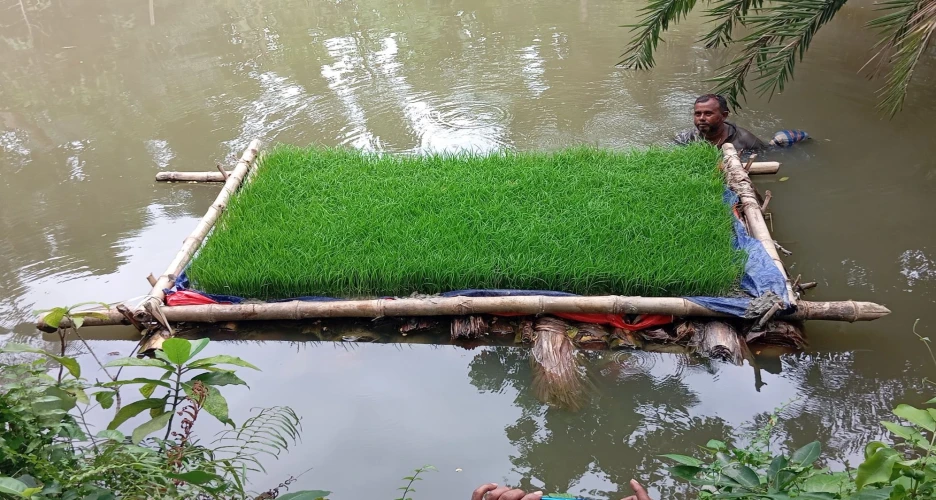
With modest financial assistance and technical guidance from AOSED, community members built floating seedbeds using locally available materials such as banana trunks, bamboo, rope, and simple liners. The floating platforms were anchored in canals and ponds, allowing them to rise and fall naturally with changing water levels.
Saline-tolerant rice seeds were sown on these floating beds, ensuring that healthy seedlings could continue to grow even while surrounding farmland remained underwater.
The approach required no expensive equipment or advanced technology. It relied on local knowledge, affordable materials, and practical training that farmers could easily adopt and replicate.
Breaking the Cycle of Loss
The results were visible from the very first planting season.
Seedlings no longer washed away with the floods. Farmers were able to transplant their rice as soon as floodwaters receded, protecting both their harvests and their incomes. They no longer needed to repeatedly purchase seeds or rely on emergency loans after every monsoon.
Because many of the materials could be reused, production costs declined in subsequent seasons. More importantly, the knowledge remained within the community. As neighboring farmers observed the success of the floating seedbeds, many began building their own using the simple Bangla guide developed through the project.
What started as a small demonstration quickly became a locally owned adaptation practice.
Investing Before Disaster Strikes
The experience in Ramnathpur demonstrates that disaster resilience does not always require large infrastructure projects or costly interventions. Sometimes, relatively small and well-targeted investments can prevent much greater losses.
By protecting the most vulnerable stage of rice production, AOSED's floating seedbed initiative strengthened food security, reduced financial risks, and increased farmers' confidence in facing an increasingly unpredictable climate.
More than an agricultural innovation, the initiative represents an effective model of locally led disaster risk financing—one that empowers communities to anticipate climate risks, adapt using their own resources, and build resilience before disasters occur.
Looking Ahead
As climate change continues to intensify flooding and other weather-related hazards across coastal Bangladesh, practical community-based solutions like floating seedbeds offer a pathway toward sustainable adaptation.
The success of Ramnathpur shows that when local knowledge is combined with appropriate technical support and modest financial investment, vulnerable communities can transform recurring disasters into opportunities for resilience and growth.
Sometimes, resilience begins not by resisting the water—but by learning to float with it.